
|
|
|
|











 |
|
 |
|
|
|
|
 |
|
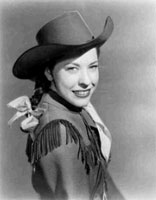
 Chanteuse
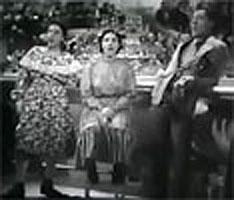
et actrice Country née Juliette Canova, le 20 Novembre 1913 à Starke (Floride). Judy Canova est décédée le 5 Août 1983.
Chanteuse
et actrice Country née Juliette Canova, le 20 Novembre 1913 à Starke (Floride). Judy Canova est décédée le 5 Août 1983.
 Judy
Canova is best remembered today as a comic actress, but she cut her share of
records from the early '30s and into the end of the '50s. As either actress or
singer, however, she was a most unlikely success story.
Judy
Canova is best remembered today as a comic actress, but she cut her share of
records from the early '30s and into the end of the '50s. As either actress or
singer, however, she was a most unlikely success story.
She was born Juliette Canova in Starke, FL, in 1916. By the time she was 12, she
and her sister, Diane, and brother, Leon, were performing together and she had
adopted the stage name Judy. The trio, known as the Three Georgia Crackers, told
jokes and sang songs on the radio in Jacksonville, which led to bookings for
nightclub performances in New York. The trio was signed to the American Record
Company in 1931, cutting hillbilly novelty songs, and later appeared in a
Broadway revue entitled Calling All Stars.
Judy Canova always stood out; she was very tall, with a wide-eyed expression
seemingly impressed upon her face. This made her ideal as a future foil in
comedy sketches, but not attractive in the conventional sense. She tried
studying classical singing only to discover that she lacked the fundamental
Vocals equipment needed for that repertory. She then decided to take advantage of
the one gift she did have — a loud voice.
Following Calling All Stars, she made her debut onscreen as a Warner Bros.
contract player, specializing in comedic material. The most notable of these
early appearances was in the film In Caliente, doing a comical rendition
of the then-current hit "The Lady in Red" under the direction of Busby Berkeley.
Then it was back to Broadway to the Ziegfeld Follies, and then more work with
her brother and sister. The trio even made it onto television before the decade
was out. They were likely the first country group to perform in the new medium,
courtesy of NBC's experimental broadcasting in 1939.
Canova had played bit parts in movies like Thrill of a Lifetime (starring
Betty Grable and Dorothy Lamour) and Artists and Models (with Jack Benny
and Ida Lupino). These were walk-ons, however, and nothing better came along
from the major studios. Then in 1940, she received an offer of a contract from
Republic Pictures, the biggest of Hollywood's "B" movie studios. Republic
specialized in producing high-quality serials and entertaining low-budget
comedies, Westerns, and action films.
Her first film for Republic, Scatterbrain, gave Canova star billing, and
this was her breakthrough. She proved a sympathetic figure on the screen, the
kind of persona audiences loved to root for. Sis Hopkins followed and was
the movie that cemented her image. Canova played an innocent good-natured
country waif new to the big city, whose honesty and fortitude allowed her to
triumph over the more sophisticated people around her. She made 13 movies for
Republic in 15 years, never veering from the role of the corn-fed Cinderella.
She often worked opposite the likes of such then-popular comedians as Jerry
Colonna and Joe E. Brown, and her co-stars included up-and-coming players like
Susan Hayward.
Canova also took advantage of her singing voice and her yodelling, both onscreen
and in the recording studio. During the early '40s, she was signed to RCA/Victor
and she later also cut sides for the Okeh, Mercury, and Varsity labels. She also
got her own radio program, The Judy Canova Show on CBS, beginning in 1943, which
proved even more successful than her movies. In 1945, the program moved to NBC
and became one of the Top Ten most popular radio shows in the country, drawing
18 million listeners at the peak of her career. A mix of country comedy and
music, Canova's program was the forerunner to television series such as The
Beverly Hillbillies. There was a serious, patriotic side to her work during
World War II, when one of her most popular numbers was her show-closer, a
version of the Patsy Montana song "Good
Night Soldier." She also sold a lot of War Bonds and entertained thousands of
soldiers.
Canova's radio show ended in 1953 and she never made the jump to television. She
preferred doing guest appearances in the new medium, in between engagements in
Las Vegas and other personal appearances. Her last film performance was in the
1960 feature Huckleberry Finn and she was seldom seen after that, apart
from rare guest spots on shows such as Pistols 'N Petticoats in the
1960s, in which she again exploited her hillbilly persona. Her daughter Diana,
born in 1953, emerged as an actress in the late '70s with appearances on shows
like Happy Days, before getting starring roles in Soap and I'm
a Big Girl Now.
Judy Canova died in 1983 after a long battle with cancer. Her movies aren't
shown very much anymore, even on television, but there's no mistaking the tall,
big-voiced country girl, a unique persona in movies and music for three decades.
https://en.wikipedia.org/wiki/Judy_Canova
Talents : Vocals, Comedy, Actress
Style musical : Yodeling, Comedy, Country-Pop, Americana, Western Swing
|
I Wish I Was A Single Gal Again (1928)
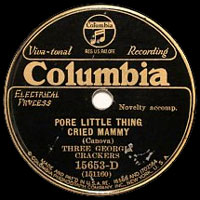
Poor Little Thing Cried
Mammy (1931)
NEVER
TRUST A MAN (1939)
STARS AND STRIPES
ON IWO JIMA
(1945)
I
WAS WRONG (1947)
|
|
Years in activity :
| 1910 | 20 | 30 | 40 | 50 | 60 | 70 | 80 | 90 | 2000 | 10 | 20 |
DISCOGRAPHY
78 t. & Singles
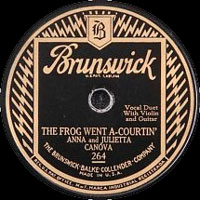
| 1928 | 78 t. BRUNSWICK 264 (US) |
The Frog Went Courting (Anna & Julietta
Canova) /
I Wish I Was A Single Gal Again
 (Julietta
Canova) (Julietta
Canova) |
| 1930 | 78 t. CHAMPION 16146 (US) | THREE CRACKERS - Hannah My Love / Reckless Love Champion |
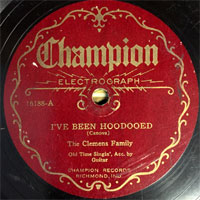
| 1930 | 78 t. CHAMPION 16188 (US) | CLEMENS FAMILY - I‘ve Been Hoodooed / Poor Little Thing Cried Mammy |
| 1930 | 78 t. COLUMBIA 15630-D (US) | THREE GEORGIA CRACKERS - I've Been Hoodooed / Whoa Buck Whoa |
| 1931 | 78 t. COLUMBIA 15653-D (US) |
THREE GEORGIA CRACKERS -
Poor Little Thing Cried Mammy
/ Hannah My
Love |
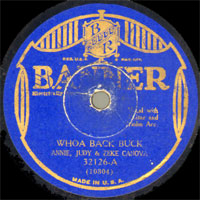
| 1931 | 78 t. BANNER 32126 (US) |
Annie, Judy & Zeke Canova - Whoa Black Buck / Hannah, My Love |
| 1931 | 78 t. PERFECT 12684 (US) | Annie, Judy & Zeke Canova - Whoa Black Buck / Hannah, My Love |
| 1931 | 78 t. ORIOLE 8043 (US) | Annie, Judy & Zeke Canova - Whoa Black Buck / Hannah, My Love |
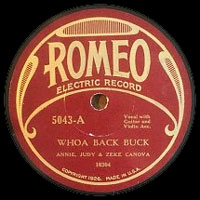
| 1931 | 78 t. ROMEO 5043 (US) | Annie, Judy & Zeke Canova - Whoa Black Buck / Hannah, My Love |
| 1931 | 78 t. BANNER 32127 (US) | Annie, Judy & Zeke CANOVA - The Poor Little Thing Cried Mammy / Reckless Love |
| 1931 | 78 t. PERFECT 12685 (US) | Annie, Judy & Zeke CANOVA - The Poor Little Thing Cried Mammy / Reckless Love |
| 1931 | 78 t. ORIOLE 8044 (US) | Annie, Judy & Zeke CANOVA - The Poor Little Thing Cried Mammy / Reckless Love |
| 1931 | 78 t. ROMEO 5044 (US) | Annie, Judy & Zeke CANOVA - The Poor Little Thing Cried Mammy / Reckless Love |
| 1931 | 78 t. BANNER 32137 (US) | Annie, Judy & Zeke Canova - Snake Eyed Killing Dude / The Fatal Shot |
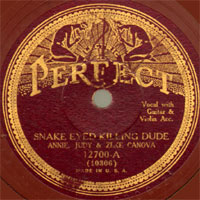
| 1931 | 78 t. PERFECT 12700 (US) | Annie, Judy & Zeke Canova - Snake Eyed Killing Dude / The Fatal Shot |
| 1931 | 78 t. ORIOLE 8057 (US) | Annie, Judy & Zeke Canova - Snake Eyed Killing Dude / The Fatal Shot |
| 1931 | 78 t. ROMEO 5057 (US) | Annie, Judy & Zeke Canova - Snake Eyed Killing Dude / The Fatal Shot |
| 1934 | 78 t. OKEH 45576 (US) | ANNE, JUDY & PETE - When The Sun Goes Down Behind The Hill (And The Moon Begins To Rise) / Me And My Still |
| 1934 | 78 t. OKEH 45578 (US) | ANNE, JUDY & ZEKE With PETE - Mississippi Waters / Don‘t Let My Mother Know |
| 1939 | 78 t. VARSITY 8054 (US) | Judy CANOVA - Go To Sleep, Little Baby / Maw And Paw |
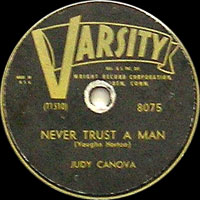
| 1939 | 78 t. VARSITY 8075 (US) |
Judy CANOVA -
Bananas Ain't Got No Bonies /
Never
Trust A Man
|
| 1939 | 78 t. VARSITY 8076 (US) | Judy CANOVA - I Ain't Got Nobody / Twenty-Five Chickens, Thirty-Five Cows |
| 1939 | 78 t. VARSITY 8077 (US) | Judy CANOVA - Out On The Plains / No Letter Today |
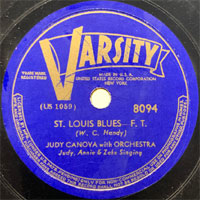
| 1939 | 78 t. VARSITY 8094 (US) | Judy CANOVA - St. Louis Blues / Time For Jokin |
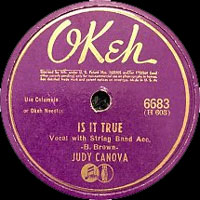
| 06/1942 | 78 t. OKEH 6683 (US) | Judy CANOVA - Is It True / Some One |
| 1942 | 78 t. COLUMBIA 36603 (US) | Judy CANOVA - Is It True / Some One |
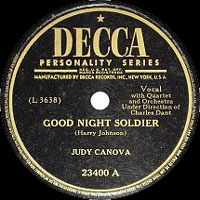
| 03/1945 | 78 t. DECCA 23400 (US) | Judy CANOVA - Good Night Soldier / A Tiny Little Voice (In A Tiny Little Prayer) |
| 09/1945 | 78 t. DECCA 23447 (US) |
Stars And Stripes On Iwo Jima
(Judy CANOVA & The
RIDERS ON THE PURPLE SAGE)
/ You Don't Have To Say You're Sorry (Judy CANOVA) |
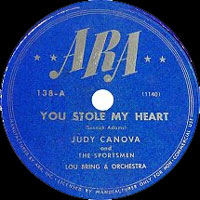
| 05/1946 | 78 t. ARA 138 (US) | Judy CANOVA & The SPORTSMEN - You Stole My Heart / It Couldn’t Be True (Or Could It) |
| 1946 | 78 t. ARA 4007 (US) | Judy CANOVA - My Fickle Eye / Apple On A Sick |
| 1946 | 78 t. ARA 4010 (US) | Judy CANOVA - Go To Sleep, Little Baby / No Vacancy |
| 08/1946 | 78 t. STERLING SR 106 (US) | Judy CANOVA - St. Louis Blues / Time For Jokin |
| 1946 | 78 t. VARSITY 8103 (US) | Judy CANOVA - Smarty Pants / Down The Alley And Over The Fence |
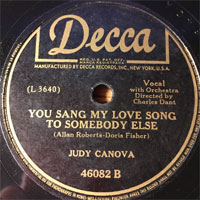
| 11/1947 | 78 t. DECCA 46082 (US) |
I Was Wrong
(Judy CANOVA & The
RIDERS ON THE PURPLE SAGE) / You Sang My Love Song To Somebody Else
(Judy CANOVA) |
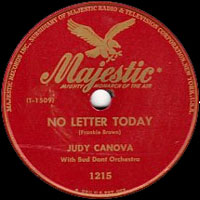
| 02/1948 | 78 t. MAJESTIC 1215 (US) | Judy CANOVA - No Letter Today / Never Trust A Man |
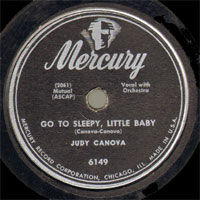
| 1948 | 78 t. MERCURY 6149 (US) |
Judy CANOVA - Go To Sleep, Little Baby / I Ain't Got Nobody |
| 1951 | SP ROYALE 45225 (US) | Judy CANOVA - Go To Sleep, Little Baby / B: Maw And Paw |
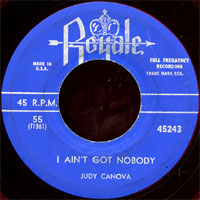
| 1951 ? | SP ROYALE 45243 (US) | Judy CANOVA - Twenty-Five Chickens And Thirty-Five Cows / I Ain't Got Nobody |
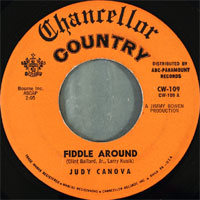
| 12/1962 | SP CHANCELLOR COUNTRY CW-109 (US) | Judy CANOVA - Fiddle Around / Mr. Heartache And Mr. Blue |
|
|
|
|
|
|
|
|
|
|
|
|
|
|
|
|
|
|
|
|
|
|
|
|
Albums
| 1950 | LP 10" ROYALE VLP-6108 (US) |
 |
FAVORITE SONGS BY JUDY CANOVA - Go To Sleepy Little Baby / I Ain't Got Nobody / Twenty-Five Chickens Thirty-Five Cows / Maw And Paw / Never Trust A Man / No Letter Today / Bananas Ain't Got No Bonies / Out On The Plains | ||
| 1957 | LP 12" TOPS L1541 (US) |
 |
HOOSIER HOT SHOTS / JUDY CANOVA - HOOSIER HOT SHOTS : There's No Romance In You Soul / Meet Me By The Ice House, Lizzie / Them Hillbillies Are Mountain Willies Now / I Like Bananas (Because They Have No Bones) / Mister Sandman / Judy CANOVA : Just Because / Ain't Gonna Grieve My Lord Any More / Go To Sleep Little Baby (Judy / The Butcher's Boy / Tons Of Love | ||
| 1958 | LP 12" TOPS L 1613 (US) |
 |
JUDY CANOVA IN HI-FI - Just Because / Wabash Blues / Ain't Gonna Grieve My Lord Anymore / Go To Sleepy Little Baby / The Butcher's Boy / Blow The Whistle / Wabash Cannon Ball / It's About Time / I Don't Know Why / Tons And Tons Of Love / Follow Me / I Was Wrong | ||
| 1960 | LP 12" RCA CAMDEN CAL 662 (US) |
 |
JUDY CANOVA WITH MEL BLANC, HANS CONRIED, VERNA FELTON, JOE KEARNS, SHELDON LEONARD - Meet The Folks / Two Gun Judy Saloon / Ma And Pa / Two Gun Judy / More Ma And Pa / Two Gun Judy | ||
| 1963 | LP 12" HURRAH H-1051 (US) |
|
HOOSIER HOT SHOTS / JUDY CANOVA - HOOSIER HOT SHOTS : There's No Romance In You Soul / Meet Me By The Ice House, Lizzie / Them Hillbillies Are Mountain Willies Now / I Like Bananas (Because They Have No Bones) / Mister Sandman / Judy CANOVA : Just Because / Ain't Gonna Grieve My Lord Any More / Go To Sleep Little Baby (Judy / The Butcher's Boy / Tons Of Love | ||
| 1964 | LP 12" CORONET CX-239 (mono) / CXS-239 (stereo) (US) |
 |
|
||
| 196? | LP 12" Manhattan MANS 539 (US) |
 |
Real Western Style - Judy Canova - Lew Raymond & His Orchestra - Just Because / Wabash Blues / Ain’t Gonna Grieve My Lord No More / Go To Sleep Little Baby / The Butcher’s Boy / Blow The Whistle / Wabash Cannon Ball / It’s About Time / I Don’t Know Why / Tons And Tons Of Love / Follow Me / I Was Wrong |
||
| 196? | LP 12" CRAFTSMEN C 8062 (US) |
 |
MISS COUNTRY USA - Judy CANOVA - Just Because / Wabash Blues / Ain't Gonna Grieve My Lord Anymore / Go To Sleepy Little Baby / The Butcher's Boy / Blow The Whistle / Wabash Cannon Ball / It's About Time / Tons And Tons Of Love / Follow Me | ||
| 196? | LP 12" VIKING VKS 8802 (US) |
 |
Featuring Judy Canova - The Butcher's Boy / Wabash Blues / Brahma Bull / Blue Tail Fly / Golden Slippers / Wabash Cannonball / Tons Of Love / Follow Me / Wayfaring Stranger / Old Fall River Line |
||
| 197? | LP 12" SUTTON SSU 296 (US) |
 |
FEATURING JUDY CANOVA SINGING COUNTRY FAVORITES WITH ESMERELDY- Wabash Blues / Tons Of Love / Follow Me / The Butcher's Boy / Wabash Cannon Ball / Skip To My Lou / Clementine / Billy Boy / On Top Of Old Smokey / Ain't Gonna Grieve My Lord No More | ||
| 02/1998 | CD SIMITAR 55682 (US) |
 |
COLLECTORS EDITION - Just Because / Wabash Blues / Ain't Gonna Grieve My Lord Anymore / Got To Sleep Little Baby / Butcher Boy / Blow The Whistle / Wasbash Cannon Ball / It's About Time / I Don't Know Why (I Just Do) / Tons And Tons Of Love / Follow Me / I Was Wrong | ||
| 05/2005 | CD COLLECTOR'S CHOICE 1061 (US) |
 |
OZARK NIGHTINGALE - I Can't Give You Anything But Love, Baby / Lonely World / Too Late To Worry / Along The Navajo Trail / No Letter Today / Walking The Floor Over You / Stuff Like That There / You Are My Sunshine / Some Of These Days / Wabash Blues / Just Because / You'll Never Know / After You've Gone / Put Your Arms Around Me, Honey | ||
| 03/2014 | CD SEPIA 1250 (US) |
 |
Time For Judy Canova - Rare Recordings 1928-1962 - The Frog Went A-Courtin / Hannah My Love / Pore Little Thing Cried Mammy / Smarty Pants / St. Louis Blues / Down The Alley And Over The Fence / Time For Jookin / Is It True? / Some One / Good Night Soldier / A Tiny Little Voice / You Don’t Have To Say You‘re Sorry / Stars And Stripes On Iwo Jima / You Stole My Heart / It Couldn‘t Be True / My Fickle Eye / Apple On A Stick / Go To Sleepy, Little Baby / No Vacancy / I Ain‘t Got Nobody / Twenty Five Chickens, Thirty Five Cows / Never Trust A Man / No Letter Today / Bananas Ain‘t Got No Bonies / Out On The Plains / Fiddle Around / Mr. Heartache And Mr. Blue |
© Rocky Productions 26/10/2022